Template for project planning

Today I got a message from my mentee about her new project, and a couple of really thoughtful questions. I love when people are open, eager to learn, and honest about their abilities.
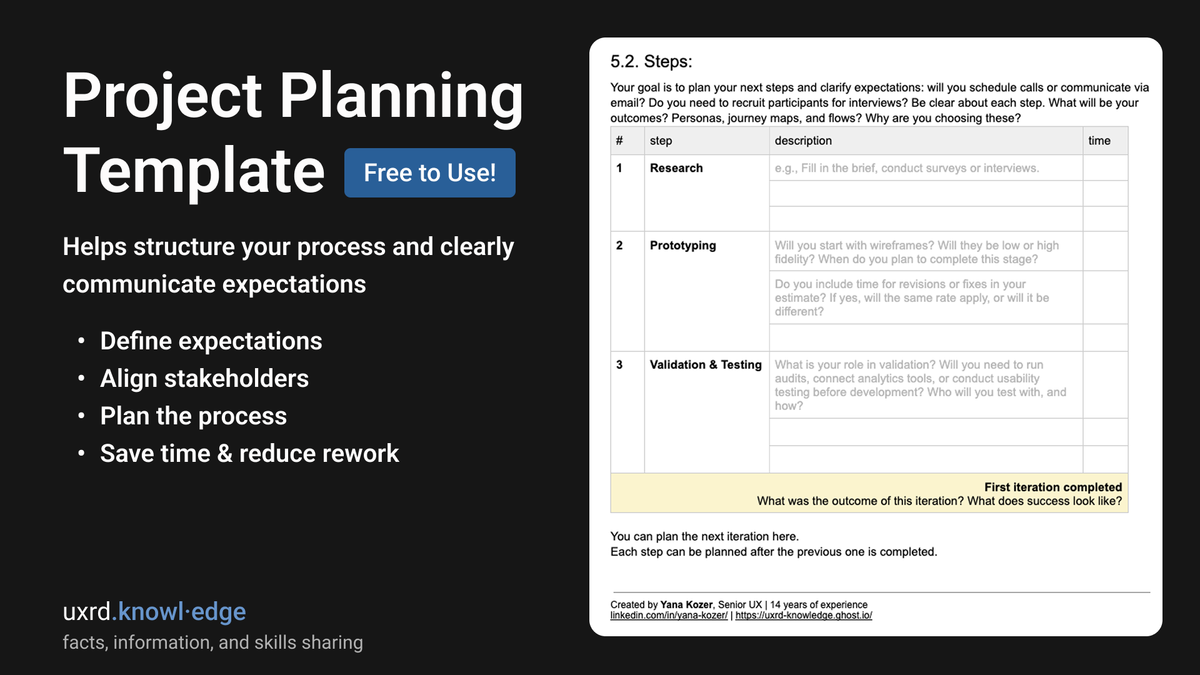
It reminded me of a structure I created back in 2016 while working on website designs and a few freelance product projects. So, I decided to share it with you too: a planning framework that has served me as both a guidance tool and a conversation starter in many projects.
From the very beginning of my career, I’ve had one obsession: structure.
I always wanted to make sure everyone was aligned from the start.
Over the years, I’ve seen how quickly expectations and planning shift or become blurred in the rush to build something. That’s why I realized early on how important it is to align on expectations from the very beginning.
It builds trust, saves time, and makes you look like the pro you are.
Because let’s be real, no one else knows what you need, how long it will take, or how complex it is… unless you explain it.
So I built my template for project planning, something to gather the right info, set boundaries, and define goals.
Since then, it’s helped me in at least 20+ discovery projects.
Funny enough, I wasn’t always the one doing the design. Sometimes I was just there to define the needs, steps, and process.
Now I’m sharing this template I created in 2016 (and updated over time). I hope it serves you as a helpful guide or learning tool.
Here’s what it helps you define:
- Client & Contact Info
- Project Overview → Goals, desired outcomes, content needs
- Key Messaging & Tone → How the brand and product should feel
- Target Audience → Who it’s for, what they expect, how they’ll use it
- Website Specs → Features, functionality, content architecture, tech stack
- Example Sites → Inspiration, competitive analysis, likes/dislikes
- Schedule & Time Planning → Weekly time estimate, deadlines, iterations
- Strategic Steps → Research → Prototyping → Validatio
Feel free to copy and adapt it to your needs.
And if you find it useful, let me know! I’d love to hear how you use it.
It’s perfect for:
- Researchers, Designers, or Managers in freelance or early-stage projects to structure the work
- Education
- Anyone who needs to bring clarity to the beginnings of a project